How to Automate Cropster
Cropster automates the roastery: Roasting Intelligence logs each batch off the machine, green inventory updates after every roast, usage projections predict run-out dates, and inventory level alerts fire on low lots. Shipments in transit, importer offers and quiet wholesale accounts sit outside it, and that is where an agent like WebRun earns its place.
 Written by
Elliot Nakamura
Platform writer
Written by
Elliot Nakamura
Platform writer
 Reviewed by
Devon Ruiz
Workflow engineer
Reviewed by
Devon Ruiz
Workflow engineer
The roast log is the memory of a coffee business
Cropster is the production platform specialty coffee roasters run their week on. It connects to the machine itself, so every batch that comes off the drum leaves a curve behind: the charge temperature, the rate of rise, where first crack landed, how long development ran.
That log is not a nice-to-have. A roastery sells consistency. A wholesale customer who liked last month's bag expects this month's to taste the same, and the only way to make that true across two roasters, three staff and a coffee that changed crop year is to have last time's numbers on screen while you roast.
So Cropster ends up holding more than curves. It holds the green inventory, what each lot cost to land, the cupping scores, the blend recipes, the production schedule and the orders those roasts are for. For a lot of roasteries it is the only complete picture of the business that exists anywhere.
Roasting is the shortest part of the day
Nobody who started a roastery expected the roasting to be the small part.
A roast day might be four hours on the machine. The rest is somebody at a laptop. Wholesale orders arrive by email, by text and through a form, and each one gets typed up. The importer sends a spot list as a PDF and somebody reads it against what is running low. A container is somewhere between Antwerp and the warehouse, and finding out where means a booking reference and a shipping line's website. Cafe accounts that used to order every fortnight have gone quiet and nobody has noticed. Subscription boxes need a packing list. Courier tracking needs checking because a customer emailed to ask.
None of it is coffee. All of it is why the owner is still at the laptop at seven.
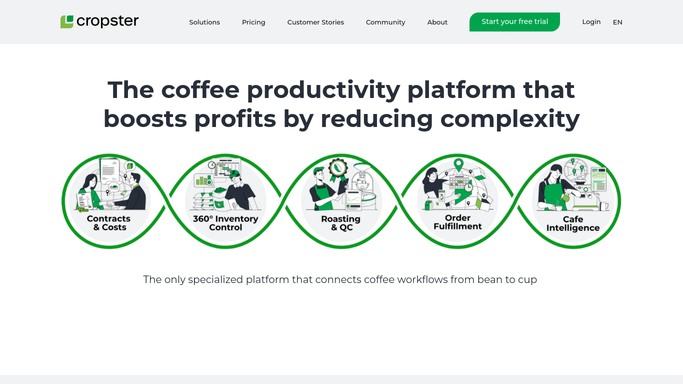
Everything Cropster automates happens inside the roastery
Cropster does a lot without being asked, and it is worth setting up properly before paying for anything else.
Roasting Intelligence reads the machine live and can auto-mark development events on the curve, so colour change and first crack are logged without a keyboard, and a profile can be replayed on the next batch. Green inventory updates itself after every roast, so the stock figure moves without a stock take, and green coffee usage projections predict when a lot will run out from what is scheduled. Inventory level alerts fire when a lot drops below where you want it. Roast scheduling, batch calculation tools and repeat scheduling turn an order book into a roast plan. Cropster Cup runs cupping sessions on custom forms. Lot traceability follows a bag back to its contract, and production reporting summarises output over any period.
All of that is real, and most roasteries use about half of it.
The edge is the roastery door. Cropster knows what you roasted and what you have left. It does not know that a container has been sitting at the port for nine days, that an importer has dropped the price on a Colombian you buy every year, or that a cafe account has not placed an order since March.
A roastery that sees the container before the invoice does
Nine days at the port is a matter of public record, available to the roastery the whole nine days.
The shipping line's tracking page checked against every green contract in transit, so a delay shows up as a line in the morning summary rather than as a coffee you cannot roast next week. Importer spot lists read as they are published and matched against what your projections say you are about to run out of, so the offer that just landed and the gap in your inventory find each other.
Wholesale accounts that have gone quiet, surfaced by name, with when they last ordered and what they usually take. For a roastery that is the most valuable list in the building, and nobody ever has time to build it.
Courier tracking for the boxes that went out on Tuesday, with anything that stopped moving pushed to the top. What a comparable single origin is going for elsewhere this week. Whether the cafe you supply is still listing your coffee on their menu page.
Set the line at the customer. Reading, checking and listing can run on its own overnight. An email to a wholesale account gets written, then read by a person, then sent.
Growth in coffee is limited by admin, not by capacity
A roastery that doubles its output does not double its roasting hours. It doubles the tabs: more contracts in transit, more accounts to watch, more tracking numbers, more offers to read.
WebRun is an AI agent that works a real Chrome browser, signed in as you. It opens the shipping line, the importer's portal, the courier or the customer's own site, reads what is on the screen, and puts the answer where you will see it.
Because it drives the browser rather than an API, it reaches whatever you can reach, with no key to generate and no integration to build first. It runs on your schedule in your own private environment, you can watch a run and stop it, and anything going to a customer is drafted and waits.
The workflows below are already built, and each one names what it opens.
Questions people ask
Will it change our roast records or inventory in Cropster?
Only where you point it, and most of what is useful here is read-only. Curves and cupping scores are not touched. Where a workflow does write, such as logging an arrival against a contract, the template says exactly what it writes before you turn it on.
Do we need the Cropster API for this?
No. It works Cropster in a browser signed in as you, with the access you already have. That matters most for the other side, because a shipping line or an importer's portal is unlikely to offer an API at all.
Can it help with green we have not bought yet?
Yes, and that is often the best use of it. Offers on an importer's site can be read as they are posted and lined up against the lots your usage projections say are running out, so buying decisions start from a list rather than from a PDF somebody remembered to open.
23 ready-made Cropster workflows
Each one names the apps it touches and the exact steps it takes. Open one to read what it will do, then turn it on.

 Shopify›
 Shopify›

Want one of these running on your own Cropster?
Show WebRun the process once and it will run it on schedule, in your own private browser environment.