How to Automate Healthy Roster
Healthy Roster automates the athletic training record itself. Injuries and treatments are documented from a phone on the sideline, digital forms and secure chat reach athletes and parents, and Sway adds balance and cognitive testing. Chasing clearance notes, physicals and certification renewals across other organizations is still hand work done after hours.
 Written by
Priya Raghavan
Solutions lead
Written by
Priya Raghavan
Solutions lead
 Reviewed by
Sofia Marchetti
Marketing operations
Reviewed by
Sofia Marchetti
Marketing operations
Healthy Roster is the athlete's medical record and the program's memory
Healthy Roster is an athletic training EMR, built for people who cover a sideline rather than run a clinic. Athletic trainers use it in high schools and colleges, in hospital outreach programs that place staff into schools, and on industrial sites where the athletes are warehouse workers.
What lives in it is the ordinary substance of the job. An ankle rolled in Tuesday's practice. The treatments that followed it. Digital forms an athlete or a parent filled in. A concussion protocol working through its stages. The list of who is currently unavailable, which is the one fact a coach wants and the one that changes daily.
The person keeping all of that current is often the only medical professional in the building. In a high school the athletic trainer is the emergency response, the rehab plan, the referral, the parent conversation and the record keeper, sometimes across three sports in a single afternoon.
The trainer's evening is spent on forms, not athletes
The clinical part of the day ends when the last athlete leaves the training room. The administrative part starts.
Somebody has to know which athletes have a current physical on file before the first practice, and that means holding a roster from the athletic department against a stack of forms signed by a dozen different family doctors. Somebody has to chase the parent who never returned the consent. Somebody has to call an orthopedic office to ask whether a clearance note was signed, because a coach asked at lunchtime and will ask again tomorrow.
Then there is the trainer's own file. A certification with a reporting deadline. A state license with a renewal window. CPR and first aid cards that expire quietly. For an outreach program running six trainers across six schools, that is a spreadsheet somebody maintains from memory.
None of it is difficult. All of it is a login or a phone call, repeated, at the end of a twelve-hour day.
The chart documents the injury, not the clearance around it
Healthy Roster covers the clinical record well, and it is worth being precise about how much of it.
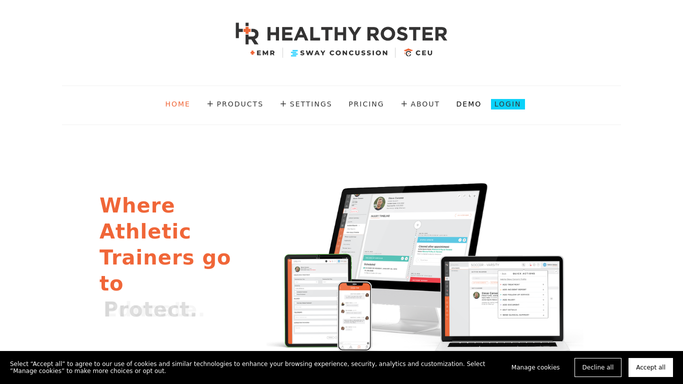
Injuries and treatments are documented from a phone, on the field or in the training room, rather than typed up hours later from scribbled notes. Secure chat carries messages between the trainer and athletes, parents, coaches and other providers without anyone handing out a personal number. Digital forms are sent, completed and filed against the athlete instead of living in a cabinet. Sway, the balance and cognitive testing the company acquired, puts FDA-cleared baseline and post-injury assessment on the same device. Reporting turns the whole picture into something an administrator or a hospital partner can read.
Every one of those acts on the athlete's record inside Healthy Roster, or on people the trainer can message directly.
The clearance note is not in there. It is at a physician's office. The physical is at a family practice. The roster that changed when a student transferred is in the school's own system. The certification a trainer has to renew sits on a national body's site behind its own login. Those are the things the week actually turns on, and the app has no route to any of them.
Return-to-play that is assembled before the coach asks
A trainer already holds all of those logins. What changes is who uses them, and at what hour.
Monday's roster checked against who has a current pre-participation physical on file, with the gaps named while there is still a week to close them. The referring office's portal read each morning for the clearance note on the athlete everybody is waiting on. Referrals tracked out and back, so a player sent for imaging three weeks ago is not quietly still waiting for someone to notice.
Certification and license renewals checked on the issuing bodies' own sites for every trainer on staff, sorted by which expires first. For an outreach program billing a school district, coverage hours held against what was actually staffed, so an invoice matches the work.
The clinical line here is firm and worth saying plainly. Gathering and comparing can run unattended. A return-to-play decision belongs to a licensed clinician, and anything that changes an athlete's record or reaches an athlete, a parent or a coach is prepared for the trainer to read and send. What goes away is the fetching, never the judgement.
Paperwork should not follow the trainer home
An evening spent on hold confirming a clearance is not athletic training, and the athlete waiting on that clearance gains nothing from the wait.
WebRun is an AI agent that works a real Chrome browser, signed in the way your staff sign in. It opens the physician's portal, the school system, the referral site or the certification body, reads what is there, and brings back a list with names and dates attached.
It runs on your schedule inside your own private environment, sessions are not shared between tools, and a workflow can be locked to an explicit list of sites. You can watch a run and stop it.
The workflows below are already built, and each one names what it opens.
Questions people ask
Will it decide when an athlete is cleared to play?
No. It finds out whether the clearance note exists and reports what it says. The return-to-play decision belongs to the licensed clinician, and nothing is written into an athlete's record without that person acting.
Is this safe with student health records?
It sees what the staff member signing in can see, and nothing more. Sessions stay inside your own private environment and are not shared between tools, and a workflow can be locked to a named list of domains.
Can it message parents and coaches for us?
It drafts and waits. Messages to a parent, an athlete or a coach are prepared for the trainer to read and send, because a status update about a minor is not something to hand to an unattended process.
12 ready-made Healthy Roster workflows
Each one names the apps it touches and the exact steps it takes. Open one to read what it will do, then turn it on.



Want one of these running on your own Healthy Roster?
Show WebRun the process once and it will run it on schedule, in your own private browser environment.