How to Automate Trello

Trello automates through Butler, which moves cards, sets due dates, posts comments and runs rules on a schedule. Butler acts on cards that already exist. Creating the card in the first place, from an order or an email or a form in another system, is the step still done by hand.

The board is how a team sees its own work

Trello is a board of lists and cards, and its whole appeal is that you can understand somebody else's work in about four seconds of looking at it.

That visibility is why it spreads through the parts of a company that never adopted a project tool. A small agency runs client work on it. A landlord runs maintenance requests. A workshop runs repairs, one card per machine, moving left to right as the job progresses.

The unit that matters is the card. A card is one real thing: a job, a fault, an application, an order. The board is honest only for as long as the cards match the things that actually exist in the world.

Which puts all the weight on how cards get made.

Cards get made by whoever remembers

The work arrives somewhere else first. It arrives as an email, a form submission, a phone call, an order in a system, a fault logged on a portal.

Then a person reads it and makes a card. They type a title, paste an address into the description, set a due date and drop it in the right list. It takes ninety seconds and it happens forty times a week.

Two things go wrong, and both are quiet. Cards that never got made, because it was busy on Thursday and nobody wrote it down, so a job simply does not exist as far as the board is concerned. And cards that were made but never updated, sitting in Doing for a fortnight after the customer cancelled.

A board people have stopped trusting gets checked less, which means it drifts further, which is how a team ends up back on a group chat.
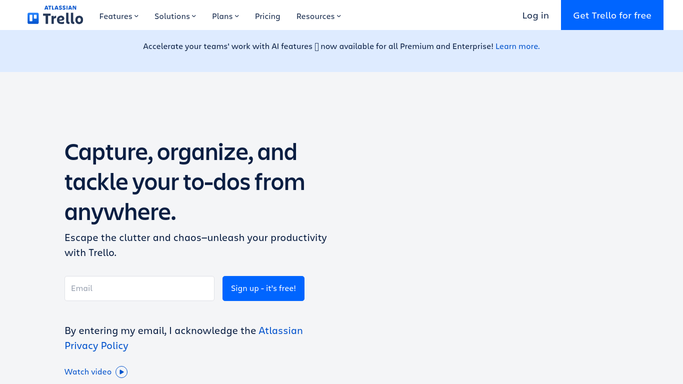
The trello.com homepage, the app these three jobs run in. Trello
Cards that create themselves A new order, application or fault becomes a card in the right list, without anyone transcribing it first.
Boards that match reality A job cancelled in the source system stops sitting on the board looking like work somebody still has to do.
Detail already on the card The reference, the address and the contact filled in, so nobody opens another system to start the job.

Butler acts on cards that already exist

Trello's automation is Butler, and it is genuinely capable for something included in the free plan.

Rules fire when a card is created, moved, labelled or has its due date arrive. Card buttons and board buttons run a set of actions on demand. Calendar commands run on a schedule, so every Monday you can sort, archive or move a batch of cards. Actions cover moving, copying, assigning, commenting, setting dates and posting to other lists.

Every one of those starts from something happening on the board. Butler is very good at what happens to a card once it exists.

It has no way to know that an order arrived in your ordering system, that a form was submitted on a site it cannot see, or that the job on that card was cancelled by a phone call this morning. The board can only react to itself.

The right card can appear on its own

The board reflects whatever was last typed into it, and nothing else. Everything missing from it was already recorded somewhere behind a login.

The overnight orders, each one a card in the intake list, with the reference and the delivery address already in the description. The faults logged on a customer's own portal, which is a site your team has a login for and no integration with. The applications submitted through a recruiting system, each becoming a card in the first column.

The updates matter as much. A job marked complete in the source system moves to Done rather than aging on the board. A cancelled visit gets archived instead of sending somebody out. A date that moved shows the date it moved to.

Worth deciding up front: let one system be the truth. If the board and the source system can both change a job's state, they will eventually disagree, and the disagreement will show up as an engineer standing outside a locked building.

Nobody has to transcribe the work first

Work arrives as an email, a form or a line in another system, and it becomes a card only when a person retypes it. That is not skilled work, but skipping it is how jobs get lost.

WebRun is an AI agent that works a real Chrome browser, signed in as you. It opens the ordering system, the customer portal or the inbox where work arrives, reads what is there, and creates or updates the cards on your board to match.

It runs on your schedule in your own private environment, and you can watch a run and stop it. Anything that would contact a customer drafts and waits for a person.

The workflows below are already built, and each one shows the steps it takes.

Questions people ask

Should we use this instead of Butler?

No, alongside it. Butler is the right tool for what happens once a card exists, and it is free. This handles the part Butler cannot reach: creating and updating cards from systems outside Trello.

Will the board fill up with duplicates?

Each workflow matches on a reference from the source system, so a second run updates the card it already made. Cards it has created can also be kept in their own list until someone triages them.

Does it work with a free Trello plan?

Yes. It works the Trello interface signed in as you, so anything you can do by hand on your current plan it can do too. There is no Power-Up to install.

1,079 ready-made Trello workflows

Each one names the apps it touches and the exact steps it takes. Open one to read what it will do, then turn it on.

Automated HappyFox Ticket Triage
As each HappyFox ticket lands, WebRun sets the category, priority, and assignee, mirrors it onto a Trello card, and messages the support lead on WhatsApp.
HappyFoxTrelloWhatsApp
Automated Groove Knowledge Base Gap Finder
Every Monday, WebRun reads last week's answered Groove tickets, finds the questions with no article behind them, and files each gap as a Trello card.
GrooveTrelloAirtable
Automated Glitch Project Link Checks
Every Monday, WebRun checks each published Glitch project link, opens a Trello card for the ones that no longer resolve, and sends the summary to your team on WhatsApp.
GlitchTrelloWhatsApp
Automated Gitpod Idle Workspace Reports
Every hour, WebRun finds Gitpod workspaces left running with nobody in them, opens a Trello card for each owner, and messages the platform team on WhatsApp.
GitpodTrelloWhatsApp
Automated Ghost Member Churn Alerts
Every morning, WebRun finds Ghost members who cancelled or whose payment failed, opens a win back card in Trello with their history, and sends the list to WhatsApp.
GhostTrelloWhatsApp
Automated Gadu-Gadu File Archiving
Every morning, WebRun goes through your Gadu-Gadu conversations, collects the files people sent you, and archives each one by sender and date so you can find it later.
Gadu-GaduNotionTrello
Automated Quipu Accepted Quote Billing Check
Every morning, WebRun finds Quipu quotes a client accepted but nobody invoiced, cards each one in Trello, and keeps the unbilled register in Notion.
QuipuNotionTrello
Automated Mailbird Licence Renewal Checks
Every Monday, WebRun reads your Mailbird licences, devices and renewal date, logs them in Notion, and files a Trello card for every seat to reclaim.
MailbirdNotionTrello
Automated Time Off Approval Queues
Every morning, WebRun reads pending Freshteam time-off requests and who is already out, opens a Trello card per approver, and sends managers a WhatsApp summary of what is waiting.
FreshteamTrelloWhatsApp
Automated Freshcaller Credit Balance Alerts
Every morning, WebRun reads your Freshcaller credit balance and number renewal dates, tracks the burn rate in Notion, and raises a Trello card before the balance runs low.
FreshcallerNotionTrello
Automatic Email Action Item Extraction
Every morning, WebRun reads your Foxmail inbox for messages that request something, writes each one into Notion as a task, and opens a Trello card for anything with a deadline.
FoxmailNotionTrello
Automated FilesAnywhere Share Link Reviews
Every Monday, WebRun lists the FilesAnywhere share links that are still live, records who can open each one in Notion, and opens a Trello card for every link from a project that finished months ago.
FilesAnywhereNotionTrello
Automated FileCloud Share Link Audit
Every Monday, WebRun audits your FileCloud share links, writes the exposure report into Notion, and opens a Trello card for every share that never expires.
FileCloudNotionTrello
Automated FacturaDirecta Modelo 303 Prep
Every Monday, WebRun totals the quarter's invoices and expenses in FacturaDirecta for the modelo 303, opens a Trello card for every expense missing a receipt, and texts you the running figures.
FacturaDirectaTrelloTwilio
Automated Expo Credential Expiry Alerts
Every Monday, WebRun reads the expiry dates on your Expo distribution certificates and provisioning profiles, logs them in Airtable, and raises a renewal card in Trello.
ExpoTrelloAirtable
Automated EverWebinar Attendance Reporting
Every Monday, WebRun reads registrations, attendance, and replay views for each EverWebinar session, writes the scorecard into Notion, and opens a Trello card for the weak ones.
EverWebinarNotionTrello
Automated eGain Case Reply Drafting
When a ticket arrives, WebRun reads the case in eGain, finds the matching knowledge article, drafts an answer for the agent to approve, and cards it up on Trello.
eGainTrelloWhatsApp
Automated Dynadot DNS Change Monitoring
Every morning, WebRun compares the DNS, name servers and lock settings on your Dynadot domains against yesterday, opens a Trello card per change, and pings you on WhatsApp.
DynadotTrelloWhatsApp
Automated dYdX Weekly Trading Reviews
Every Monday, WebRun opens dYdX, adds up last week's fills, realized profit and loss, and funding payments, files the review on Trello, and texts you the headline.
dYdXTwilioTrello
Automated Domo Stale Dataset Alerts
Every morning, WebRun reads the last update time on every Domo dataset, raises a Trello card for anything stale, and warns the analytics owner on WhatsApp.
DomoTrelloWhatsApp
Automatic Dick's Price Drop and Restock Alerts
Every morning, WebRun checks the Dick's Sporting Goods products you are watching for a price drop or a size back in stock, logs the move in Notion, and adds a buy card to Trello.
Dick's Sporting GoodsNotionTrello
Automated Devin ACU Usage Budget Alerts
Every morning, WebRun reads how much your Devin sessions have consumed this billing period, tracks the burn rate on a Trello card, and warns you on WhatsApp if the pace is too high.
DevinTrelloWhatsApp
Automated Deno Deploy Error Alerts
Every hour, WebRun reads the logs on your live Deno Deploy projects, counts new errors, and queues anything crossing your threshold with the log lines that matter.
Deno DeployTrelloWhatsApp
Automated Deepgram API Key Access Audits
Every Monday, WebRun reads the API keys and members on your Deepgram projects, opens a Trello card for each one that looks stale, and sends you a WhatsApp summary of what to revoke.
DeepgramTrelloWhatsApp

Want one of these running on your own Trello?

Show WebRun the process once and it will run it on schedule, in your own private browser environment.