How to Automate Kipu Health
Kipu Health automates the facility's own operation. The Bed Board shows live availability, Electronic Verification of Benefits checks eligibility at admission, Chart Check tracks form deadlines, and KIP drafts notes from sessions. Utilisation review, credential checks and denial appeals happen on payer and state sites Kipu cannot open.
 Written by
Elliot Nakamura
Platform writer
Written by
Elliot Nakamura
Platform writer
 Reviewed by
Grace Okafor
Healthcare operations
Reviewed by
Grace Okafor
Healthcare operations
An admission in behavioral health happens in hours, not weeks
Kipu Health is the platform behind a large number of addiction treatment and behavioral health facilities: residential and outpatient programmes, eating disorder centres, medication-assisted treatment providers.
The rhythm of the work is what shaped the software. Someone calls, or a family member calls for them, and the window in which that person will actually walk in is measured in hours. So Kipu holds admissions, the clinical record and the claim in one place: a CRM for the enquiry and the bed, an EMR for the chart, revenue cycle for the billing, and compliance tooling around all of it.
The record it holds is more sensitive than most of healthcare. In the United States, information identifying somebody as a patient in a substance use disorder programme carries its own federal confidentiality rules on top of HIPAA. Who may see it, and what may be disclosed to whom, is not a matter of internal policy.
Continued stay is argued on the payer's schedule
The clinical work happens in the building. A surprising amount of the administrative work happens on other people's websites, against other people's deadlines.
Utilisation review is the clearest case. A patient is authorised for a few days at a level of care, and to continue, somebody has to request more, with today's clinical justification, before the current authorisation runs out. Miss it and the days are delivered unfunded. That means a person opening payer portals every morning, working down a list by payer and level of care, noting what expires when.
Around it sits the rest. Eligibility checked before admission. Denied claims collected with appeal windows that close quietly. Clinician licences and certifications, each verified on a state board's own lookup. Referrals from a hospital discharge platform nobody opened over the weekend.
In most facilities all of that is held together by one person who has memorised which portal is slowest to load.
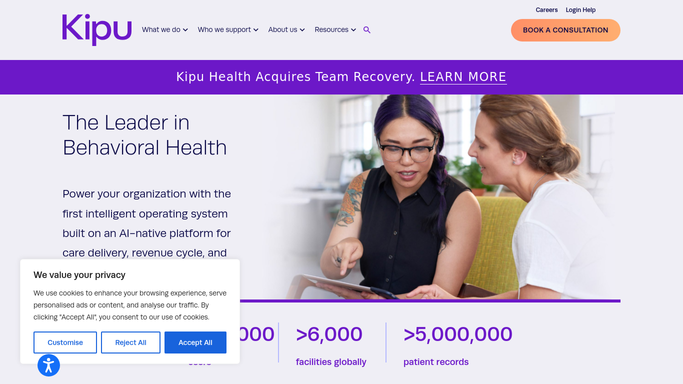
The bed board and the benefits check already run inside Kipu
Kipu automates a great deal of the facility's own day, and the built-in tooling is worth exhausting first.
On the admissions side the Bed Board shows real-time bed availability synced with the EMR, and Electronic Verification of Benefits gives an integrated eligibility check at the moment somebody is deciding whether to admit. Pre-Admission Chart Generation creates the chart from the CRM record rather than making anyone start again, and the Travel Board tracks how a patient is getting there.
On the clinical side, Chart Check sets deadlines for patient forms and tracks completion, so an incomplete chart is visible before it becomes an audit finding. KIP, the Kipu Intelligence Program, transcribes sessions, drafts progress notes and summarises charts. Kipu Helix is the platform tying these together.
All of it operates inside Kipu's own record. The eligibility check is integrated, which is genuinely useful, but the continued-stay review is not. Neither is the state licensing board, the clearinghouse holding the denial detail, or the discharge platform at the hospital that just rang about a bed.
The census can be checked against every payer each morning
Read the record and the payers' own sites together, on a schedule, and one person's spreadsheet stops being the thing the facility depends on.
Every authorisation expiring inside seven days, grouped by payer and level of care, so the continued-stay request is prepared while it still counts rather than after the days were delivered. Eligibility confirmed for everyone admitting in the next forty-eight hours, so nobody starts treatment on coverage that lapsed.
Denials pulled with their reason codes and appeal windows, ordered by which closes first. Clinician licences and certifications checked against the state board's own lookup each week, with anything close to expiry raised early, because a lapsed credential is a compliance problem and a billing problem at the same time.
Referrals read from the hospital discharge platform and the referring practice, so a warm referral does not sit in a queue over a weekend, which in this field is the difference between somebody coming in and somebody not.
The boundary in addiction treatment is stricter than almost anywhere else in healthcare. Read the portals, set them against the census and raise the mismatches: that part needs no one supervising it. Anything touching a chart or a claim, and anything at all that reaches a patient or an alumnus, is prepared for a qualified person and waits.
The record stays inside the building
Payer portals, licensing lookups and the clearinghouse each want a login and a look, and in addiction treatment there is a second condition on top: none of what comes back may leave the building.
WebRun is an AI agent that works a real Chrome browser, signed in as your own staff are, in your own private environment. Sessions are not shared between tools, and a workflow can be locked to an explicit list of domains, so it reaches the payer sites you named and nothing else. You can watch a run and stop it.
It reads and it prepares. Nothing is written into a patient's chart, no claim is filed, and no message goes to a patient or an alumnus without a qualified person approving it first.
The workflows below are already built, and each one names what it opens.
Questions people ask
Is this safe for confidential addiction treatment records?
It is built for exactly that constraint. Runs happen in your own private environment signed in as your own staff, sessions are not shared between tools, and a workflow is locked to the sites you named, so nothing is disclosed anywhere new.
Will it write into a patient chart?
No. It reads and prepares. Anything that changes a chart, files a claim or reaches a patient or an alumnus is left for a qualified person to review and send.
Does this need the Kipu API?
No. It works the screens your staff work, signed in as them, which is also how it reaches the payer portals, clearinghouse and state licensing sites that offer no API at all.
13 ready-made Kipu Health workflows
Each one names the apps it touches and the exact steps it takes. Open one to read what it will do, then turn it on.


Want one of these running on your own Kipu Health?
Show WebRun the process once and it will run it on schedule, in your own private browser environment.