How to Automate Nexus Clinical
Nexus Clinical automates the neurology chart itself: AI Scribe drafts the note, recalls and reminders bring patients back, eRx checks the PDMP, and eligibility returns while the patient is still at the desk. The infusion center, the imaging site and the payer portal sit outside it, which an agent such as WebRun reads.
 Written by
Samuel Adeyemi
Integrations writer
Written by
Samuel Adeyemi
Integrations writer
 Reviewed by
Hannah Vogel
Finance operations
Reviewed by
Hannah Vogel
Finance operations
A neurology chart is mostly a record of what happened elsewhere
Nexus Clinical is a cloud EHR and practice management platform for small and mid-sized ambulatory practices, sold to specialists rather than to hospitals. Neurology and neurosurgery sit alongside cardiology, orthopedics, podiatry, psychiatry, family medicine and general surgery on its list, and most practices know the product simply as Nexus EHR. One account carries the chart, the schedule, the billing and the patient portal.
Neurology fits that shape awkwardly well. A neurologist sees a patient for half an hour and then does not see them again for three months, and almost everything that decides the next visit happens in between. A seizure that was or was not written down. An infusion that was or was not given. An MRI read by somebody in a different building.
So the chart holds the visits, and the clinic runs on the intervals between them.
Three months of follow-up rest on one coordinator
Watch a neurology front desk for a morning and very little of it is booking.
A patient who went to an emergency department with a first seizure has a discharge summary sitting on a hospital portal, and nobody in the clinic sees it until somebody logs in. A course of Botox for chronic migraine needs a prior authorization filed on the payer's own site, renewed every few months, and denied often enough that it has to be checked. An MS patient's next infusion is booked at an infusion center that keeps its own schedule and its own waiting list. Neuropsychological testing goes to a psychologist across town with a queue measured in months. An EMG needs a room, a technologist, and a patient who remembered to stop the medication that interferes with it.
None of that is in the chart. All of it decides whether the next appointment is worth having.
Nexus already carries the note, the recall and the script
To be fair to Nexus, the inside of the visit is covered properly, and a practice should exhaust it before adding anything.
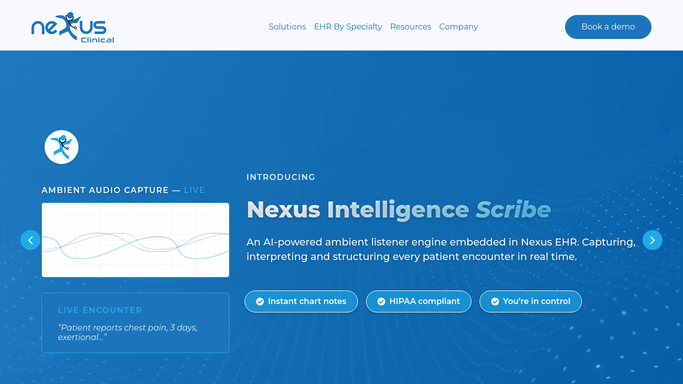
AI Scribe drafts the note from the encounter, and Rapid Charting keeps a SOAP note on a single screen with templates, free text and voice input rather than a fixed form. Patient recalls and appointment reminders handle the follow-up interval the practice controls, which covers most routine return visits. Prescribing runs through eRx with EPCS and SureScripts drug history, and a PDMP check sits in the same place, which matters in a specialty writing controlled substances daily. Real-time eligibility checks run at check-in. Orders and results move over a lab and diagnostics interface, images through an integrated DICOM and PACS viewer, and paper arrives through eFax Management and document scanning.
Every item there acts on something Nexus already holds: its own appointment, its own order, its own claim.
A payer's prior authorization portal is not one of those. Neither is the infusion center's schedule, the hospital's discharge site, or the imaging center that was never interfaced.
Referrals, authorizations and infusion dates gathered before clinic
What happens to a patient between visits is decided in other people's systems, and every one of those can be read on a schedule.
Every open prior authorization checked at the payer's portal each morning, so an approval that landed on Friday books an appointment on Monday instead of quietly expiring. Infusion center schedules read against the patients who are due, so an MS patient whose slot moved is called the same week rather than the month after. Discharge summaries collected from the hospital portal, so a first seizure seen in an emergency department on Saturday reaches the clinic before Monday clinic starts.
Outside imaging read and set against the order that asked for it, so an MRI reported nine days ago is not still marked pending. Neuropsychology and EMG waiting lists checked where they are actually kept, ordered by who has waited longest. Specialty pharmacy status for the drugs a neurology clinic prescribes, so a patient who never collected a refill is called before the gap turns into a relapse.
The interval between visits finally has an owner
The person holding those three months together is one coordinator with six logins and a spreadsheet, and the spreadsheet is the first thing to slip on a busy week.
WebRun is an AI agent that works a real Chrome browser, signed in the way your coordinator is. It opens the payer portal, the infusion center's schedule, the hospital's discharge site or the imaging center, reads what is there, and hands back a list with the patient, the date and the reason attached.
It runs on your schedule in a private environment of your own, sessions stay separate between sites, and a workflow can be limited to named domains. Gathering runs unattended. It will not change a record or reach a patient on its own; both are drafted for a clinician to approve.
Each workflow below names the sites it opens and what it leaves for you.
Questions people ask
Can it book an infusion slot for a patient?
No. It reads what the infusion center's schedule shows and hands back who is due, whose slot moved and who has no date at all. Booking a clinical appointment for a named patient stays with your coordinator, who confirms it in Nexus.
Does Nexus Clinical need an API for this to work?
No. The agent works the browser, signed in as a member of staff, the same way your team does. Nothing has to be built or switched on at the Nexus end, and the outside portals that publish no interface at all are reached exactly the same way.
Could it change something a neurologist wrote in the chart?
No. Writing to the chart is not something a workflow may do by default. It gathers from outside sites and returns a list, and anything that would alter a record or send a message to a patient is prepared for a person to approve first.
12 ready-made Nexus Clinical workflows
Each one names the apps it touches and the exact steps it takes. Open one to read what it will do, then turn it on.




Want one of these running on your own Nexus Clinical?
Show WebRun the process once and it will run it on schedule, in your own private browser environment.