How to Automate e-Emphasys
e-Emphasys automates the dealership inside its own walls. ServiceEdge triggers preventive maintenance and manages warranty, PartsEdge plans stock and runs cycle counts, RentalEdge tracks meters and utilisation, and telematics feeds machine data in. Reading manufacturer portals, freight sites and auction results still takes a person, and an agent like WebRun does that reading.
 Written by
Nikhil Bhatt
Automation strategist
Written by
Nikhil Bhatt
Automation strategist
 Reviewed by
Marta Ellison
Automation strategist
Reviewed by
Marta Ellison
Automation strategist
A dealership sells the machine once and services it for ten years
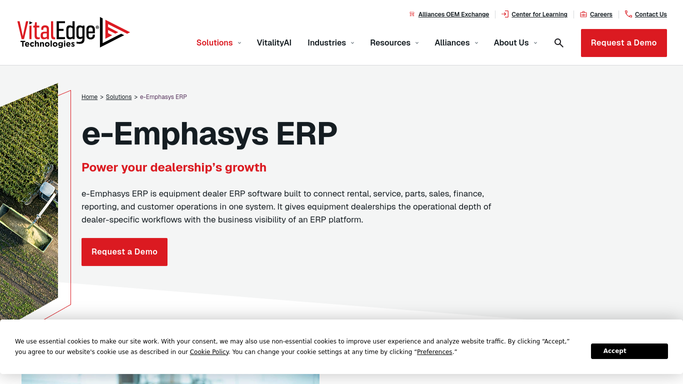
e-Emphasys, now sold by VitalEdge Technologies, is the ERP that heavy equipment dealers run on: construction and agriculture, material handling and forestry, mining and heavy truck. The suite splits along the way a dealership is organised, into SalesEdge, RentalEdge, ServiceEdge, PartsEdge and FinanceEdge.
The reason a dealer needs one system rather than five is that a machine is not a sale. It is a relationship with a serial number. An excavator goes out on a lease, comes back on a rental contract, gets a hydraulic pump under warranty in its second year, eats filters for a decade, and eventually gets traded against a newer one.
Every one of those events touches parts, service, rental and finance, and every one has to land against the same machine. That is why the counter, the shop floor, the yard and the ledger all sit in e-Emphasys.
The parts counter is on hold with three manufacturers
The work that fills a dealership's day and never appears in a process map is checking, on somebody else's website.
A technician needs a pump. The counter checks the manufacturer's dealer portal for stock, then a second manufacturer for the aftermarket equivalent, then a supplier's site for the seal kit that goes with it. The customer wants a date, so somebody opens the carrier's tracking page for the crate.
Meanwhile the warranty administrator works a queue of claims on the OEM portal and finds two rejected for a missing photograph of the failed part. Somebody else checks whether a product improvement campaign applies to a serial number on the shop floor right now, because doing it next month means a second visit and a second transport bill.
None of it needs skill, only a login, a serial number and the patience to look. It gets done when the phones stop, which in a good dealership is never, so warranty money ages out and a customer waits another day.
ServiceEdge runs the shop, the manufacturer runs the warranty
A dealer should push e-Emphasys as far as it goes first, because it goes a long way.
ServiceEdge covers contracts, OEM campaign management and warranty, with preventive maintenance triggers, scheduling and dispatch, fault codes, technician mobility on the truck, and warranty recovery reporting behind it. PartsEdge handles parts planning, warehouse mobility, automated cycle counts and core management. RentalEdge runs demand-based rates, flexible billing, contract extensions, meters, utilisation and fleet health. Power BI dashboards are embedded throughout, a customer portal takes parts orders and service requests, and there are direct integrations to major telematics platforms and to some manufacturers.
That gives a dealership that knows itself: hours read off the machine, a trigger fired, a technician dispatched, a part reserved.
The wall is that a warranty claim is only half yours. Once submitted, the answer lives on the manufacturer's portal, on their schedule. Same for parts availability at a factory depot, a campaign against a serial range, and the carrier holding the crate. Where a direct integration exists, that traffic flows. Where it does not, and for most dealers it does not for every brand, the answer is a website and a person.
A technician can be dispatched knowing the part will be there
A dealership that can read those portals overnight stops planning around what it does not know.
Parts availability and estimated arrival checked on every manufacturer portal before the counter opens, written against the work orders waiting on them, so the callback at eight gives a date, not a promise to find out. Freight tracked for anything already shipped, with a crate that stopped moving flagged before a technician is scheduled against it. Warranty claim status pulled each week, so a rejection gets its photograph and its resubmission while the window is open.
Then the ones a busy dealership never gets to. Product improvement campaigns checked by serial number against every machine booked in this fortnight. Technician certifications checked on the manufacturer's training site before a warranty job goes to somebody whose ticket lapsed. Auction results for the same make, model and hour band read off the public pages, so a trade-in is appraised against what the market paid last month.
The judgement stays put. Pricing a trade, committing to a delivery date and deciding what to stock are decisions with money attached. Finding out what the manufacturer already published is not.
An hour on hold does not fix a machine
A dealer competes on how fast a customer gets back to work, and almost none of that speed is lost in the workshop. It goes on waiting to find out something already sitting on a screen somewhere.
WebRun is an AI agent that works a real Chrome browser, signed in as you. It opens the dealer portal, the freight carrier, the campaign bulletin or the auction results, reads them the way your parts manager would, and writes the answer where the work order can use it.
It runs on your schedule in your own private environment, restricted to the sites you allow. Ordering parts, quoting a customer and submitting a claim are prepared and left for a person.
The workflows below are already built, and each one names the systems it opens.
Questions people ask
Will it order parts or submit warranty claims on its own?
Not unless you deliberately allow a narrow case. The default is that it gathers availability, dates and claim status, then leaves the ordering and the submitting to your parts manager or warranty administrator, because both cost real money to get wrong.
Some of our manufacturers have no dealer API at all. Then what?
Those are the ones this is for. It signs into the portal the same way your counter staff do and reads the screen, so a brand with no integration gets checked on exactly the same schedule as one with a direct feed.
We are mid-way through a VitalEdge upgrade. Does that matter?
No. Nothing is installed into e-Emphasys and no interface is built, so an upgrade or a version change on the ERP side does not break it. It works whichever screens your team is working on the day it runs.
13 ready-made e-Emphasys workflows
Each one names the apps it touches and the exact steps it takes. Open one to read what it will do, then turn it on.




Want one of these running on your own e-Emphasys?
Show WebRun the process once and it will run it on schedule, in your own private browser environment.