How to Automate Arryved
Arryved covers the taproom on its own: card-on-file tabs, inventory, depletion forecasting, memberships and loyalty all run off what the point of sale recorded. The gap is everything outside it, like ratings, review sites, keg accounts and bank settlement. An agent such as WebRun opens those and sets them against the pour.
 Written by
Devon Ruiz
Workflow engineer
Written by
Devon Ruiz
Workflow engineer
 Reviewed by
Yara Haddad
Data operations
Reviewed by
Yara Haddad
Data operations
A taproom tab follows the guest, not the table
Arryved was built for craft beverage, and it shows within ten minutes of a shift. Service in a taproom does not look like service in a restaurant. There are no table numbers on a lawn, guests drift between the bar, the patio and the food truck outside, and a tab opens against a card kept on file and stays open while the person wanders.
Staff take orders on a handheld rather than walking back to a terminal, and the till keeps working when the wifi at the far end of the building gives up. What is sold is unusual too: a batch that will run out, poured by the ounce, from a keg that is either on or blowing at nine on a Friday.
So the platform holds more than a day's takings. It sits across the taproom and the brewhouse at once: what poured, what is left of it, which members came in, what went out to accounts.
The club and the keg accounts get tracked by hand
Pouring is the easy part. Everything arranged around it is somebody's second shift.
The cider club is a membership business bolted onto a bar. Cards expire, and the first anyone hears of it is a failed renewal. A release pickup needs a list, a note to every member on it, then a second note to the ones who never came. Members who have not been in since spring stay invisible unless somebody goes looking.
Then there is everything outside the building. Check-ins and ratings for last week's release sit in Untappd, and reviews are spread over three sites. Whether the bar across town actually put your keg on tap is something you learn from their tap list or by driving past. The state licence portal keeps its own renewal date. And most mornings somebody opens the reports, copies yesterday's numbers into a sheet, and squares the card payouts against what the bank really deposited.
Depletion forecasting counts what the taproom poured
Arryved is not short of features, and most taprooms use a fraction of what they already pay for.
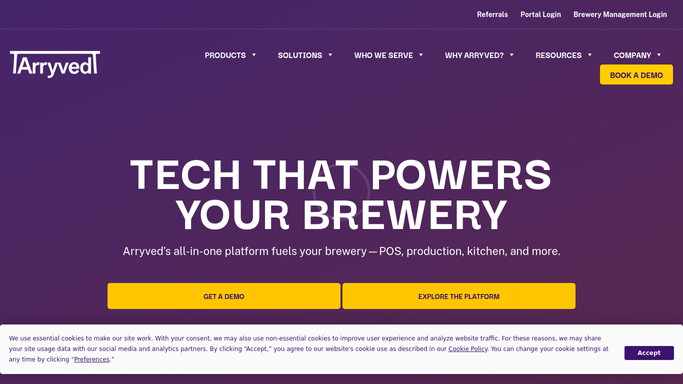
Front of house there are card-on-file tabs, QR and contactless ordering, online and to-go orders, FreshKDS on the kitchen screen, and an offline mode for when the connection drops. Arryved Pay handles the processing, so sales and settlement report together. Behind that, Brewery Management covers ingredient, keg and packaged inventory, recipe costing, batch tracking, depletion forecasting and the sales and distribution side. Web Solutions builds the site, the online shop and memberships, the Digital Menu Hub keeps the wall menu matching the POS, and Insider runs loyalty. The integration list carries real names: Ekos, QuickBooks, 7shifts, MarginEdge, Yellow Dog, Bartrack and Shogo.
Every one of those is fed by the taproom itself. Depletion forecasting knows what has been poured and sold. Inventory knows what came in the door. The membership tools know who joined and when their card runs out. None of that reaches a rating left at eleven last night, a tap list published by an account across town, or a licence page that changed status on Tuesday.
Every pour has a matching page somewhere outside the POS
The version worth having is the taproom's own numbers arriving with the outside world already attached to them.
Yesterday's sales by pour set beside the check-ins and ratings the new release picked up overnight, so the beer that sold and the beer people liked can be told apart before the next batch is scheduled. Reviews gathered from wherever guests left them, each next to the shift it refers to, so a rough Saturday gets explained instead of argued about.
Members whose cards expire this month collected into one list with a note drafted for each. A pickup list for a club release checked against who actually collected, so the second reminder goes only to those who need it. Keg accounts checked against the tap lists those bars publish themselves, so a keg that never went on shows up inside the week rather than the quarter. Card settlement squared against what the bank deposited, with only the nights that disagree put in front of a person.
Reading and comparing can run unattended, because none of it changes anything. Whatever a member or guest receives is drafted, and waits for whoever's name is over the door.
The people behind the bar should be behind the bar
The taproom does not have somebody free to sit and work through other people's websites before service. It gets done late, or on a day off, or not at all.
WebRun is an AI agent that drives a real Chrome browser, signed in as you. It opens the sites that were never going to appear on an integration list, reads what is on the screen, and puts the answer next to what Arryved already recorded. It works the browser the way a person does, so there is nothing to build first: no connector, no API, no developer.
It runs on your schedule inside your own private environment, and you can watch a run and stop it midway. Every workflow below names the sites and accounts it opens before you switch it on.
Questions people ask
Could a guest or a member be contacted without a person approving it?
No. Anything that reaches a member or a guest is written and left as a draft for someone at the taproom to send, including renewal notes, pickup reminders and review replies. The unattended part is reading and comparing, which changes nothing on its own.
Is an account tap list or a distributor site something it can open?
Yes, and that is usually the point. It signs in and reads the page the way a sales rep would, so a bar's published tap list or an account portal with no integration stops being a thing somebody has to remember to check.
Does it interfere with tabs or payments during service?
No. It reads Arryved's reporting and writes nothing into open tabs, tenders or settlement. Runs are scheduled for quiet hours by default, and each workflow names exactly which screens it opens before you turn it on.
10 ready-made Arryved workflows
Each one names the apps it touches and the exact steps it takes. Open one to read what it will do, then turn it on.




Want one of these running on your own Arryved?
Show WebRun the process once and it will run it on schedule, in your own private browser environment.